


Large Language Models are moving quickly from experiments into core business systems. Teams now use them for support automation, knowledge search, summarization, and developer workflows. | LLM
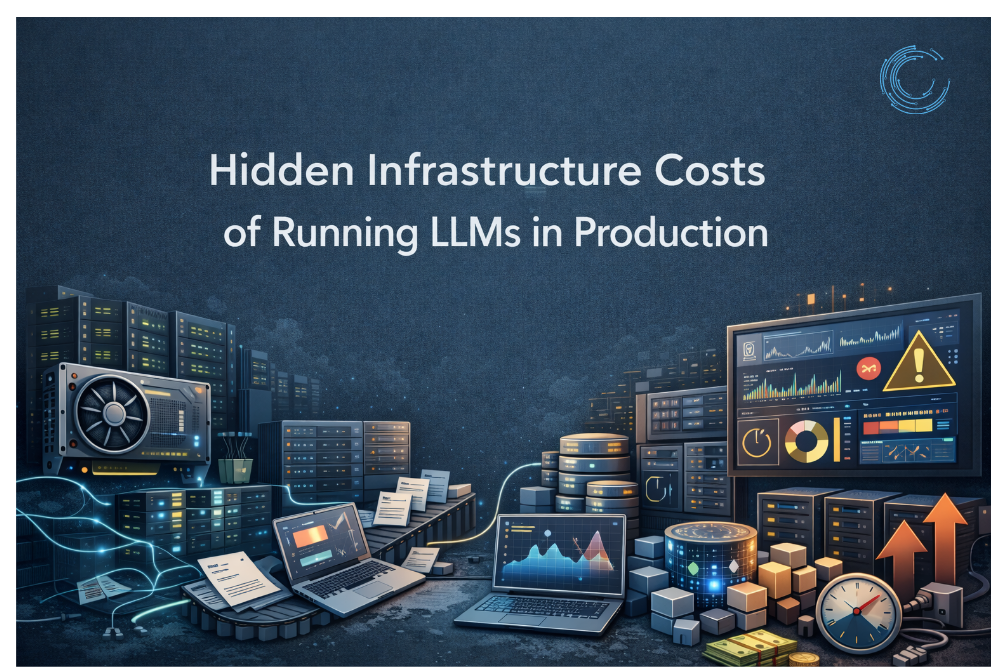
The surprise isn’t that LLMs cost money — it’s where the money actually goes.
Once usage grows, model access becomes only one part of the bill. The surrounding infrastructure starts to dominate.
Compute Costs
Computing is the most visible expense, but it’s often misunderstood. Early pilots run on small workloads and look cheap. Then traffic increases, latency targets tighten, and GPU usage scales faster than expected.
Duolingo is a good example. When it introduced conversational AI features, adoption pushed the company to optimize prompts, introduce caching, and carefully route requests across models. The goal wasn’t just performance — it was cost control.
Most teams don’t realize this until bills start climbing.
Data Pipelines and Vector Storage
Production LLM systems rely on embeddings, vector databases, and retrieval pipelines. Every document ingested and every query processed adds indexing, storage, and compute overhead.
Logging alone can double storage usage in some deployments. Over time, maintaining fast semantic search across growing datasets often requires premium storage tiers and distributed infrastructure.
Teams building internal knowledge assistants frequently discover that vector storage and retrieval costs start rivaling inference costs. It doesn’t happen on day one — it shows up months later.
Monitoring LLM Behavior
Unlike traditional software, LLM systems need continuous evaluation. Quality isn’t binary. Outputs can drift, hallucinate, or degrade in subtle ways.
That means logging pipelines, evaluation datasets, observability dashboards, automated tests, and fallback flows. Enterprises running AI support agents often maintain parallel monitoring systems specifically to detect bad responses before customers do.
These guardrails are essential. They’re also expensive and operationally heavy.
Scaling for Peaks
AI workloads are unpredictable. A product launch, a new internal rollout, or a viral feature can multiply traffic overnight.
To avoid slow responses, teams provision capacity ahead of demand. Inevitably, some of that infrastructure sits idle. You pay for readiness, not just usage. This is where finance teams start asking hard questions.
The Real Shift
Companies succeeding with LLMs treat infrastructure as product design, not backend plumbing.
They introduce response caching. They route simple queries to smaller models. They combine retrieval with fine-tuned systems. They scale based on usage patterns instead of peak assumptions.
Running LLMs in production isn’t just an AI challenge — it’s an infrastructure strategy.
Businesses that understand the full operational footprint early are the ones able to scale AI sustainably, without surprises later.