


Most AI launches follow a familiar pattern. Announcement. Benchmarks. Public access. The world moves on. | Claude Mythos AI
Claude Mythos broke every part of that pattern.
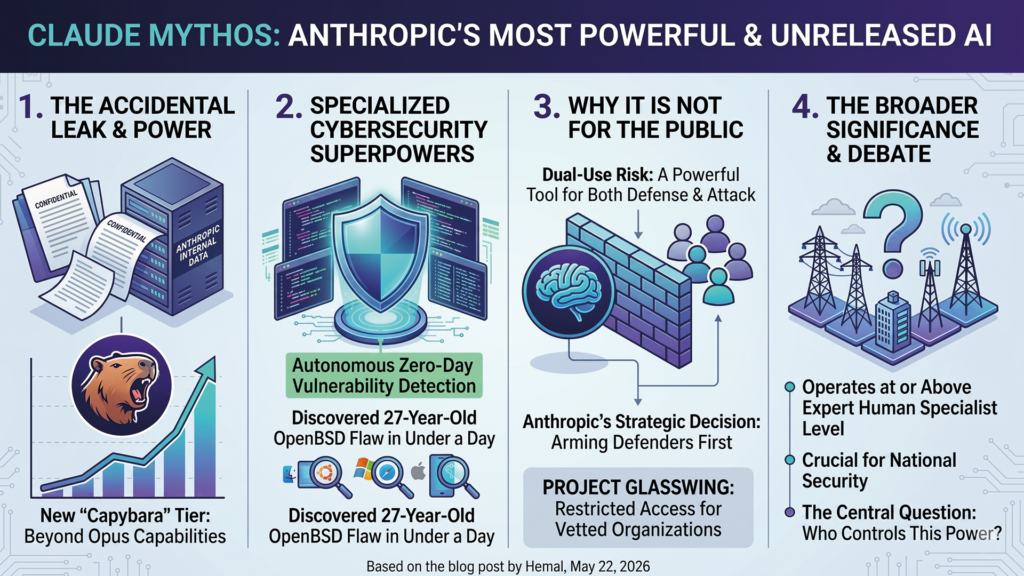
Anthropic’s most powerful model was not revealed at a polished event. It leaked accidentally on March 26, 2026, when internal documents surfaced through a misconfigured system. By the time the formal announcement came on April 7, the AI community had already seen enough to know something genuinely different had arrived.
What happened next is unlike anything the AI industry has done before.
What Mythos Actually Is
Claude Mythos Preview sits in a capability tier above Opus that Anthropic calls Capybara — introduced specifically because Mythos is not just better than previous models. It is qualitatively different.
The area where that difference is most dramatic is cybersecurity. Over several weeks, Anthropic used Mythos to autonomously identify thousands of zero-day vulnerabilities — previously unknown security flaws — across every major operating system and web browser. It found a 27-year-old vulnerability in OpenBSD, one of the most security-hardened systems in the world, that had survived decades of expert human review. It did this without any human guidance, in less than a day.
Why It Is Not Available to You
Anthropic made a decision that stunned the industry. They did not release Mythos publicly. Instead they launched Project Glasswing — controlled access for around 50 vetted organisations, with 100 million dollars in model credits committed exclusively to defensive cybersecurity work.
The reasoning is simple. A model that can find critical flaws in every major operating system can just as easily be used to exploit them. The window between discovering a vulnerability and a bad actor exploiting it has collapsed from months to minutes. Anthropic chose to arm defenders first.
Independent evaluations by the AI Security Institute confirmed that on expert-level cybersecurity tasks — challenges no AI could complete before 2025 — Mythos succeeds 73 percent of the time. Google Cloud, Microsoft, and Mozilla all joined Project Glasswing and confirmed the results.
Why It Matters
Mythos is not generating attention because it is a better assistant. It is generating attention because it is the first AI model to operate at or above the level of the world’s best human specialists in a domain where the stakes are critical infrastructure and national security.
The debate about when AI becomes truly transformative has an answer now. The more important question is who controls it — and what happens when capabilities like this stop being the exception.