


There is someone at your company who never sleeps, never takes leave, reads everything, forgets nothing, and is available the moment anyone needs them. | AI in the Workplace
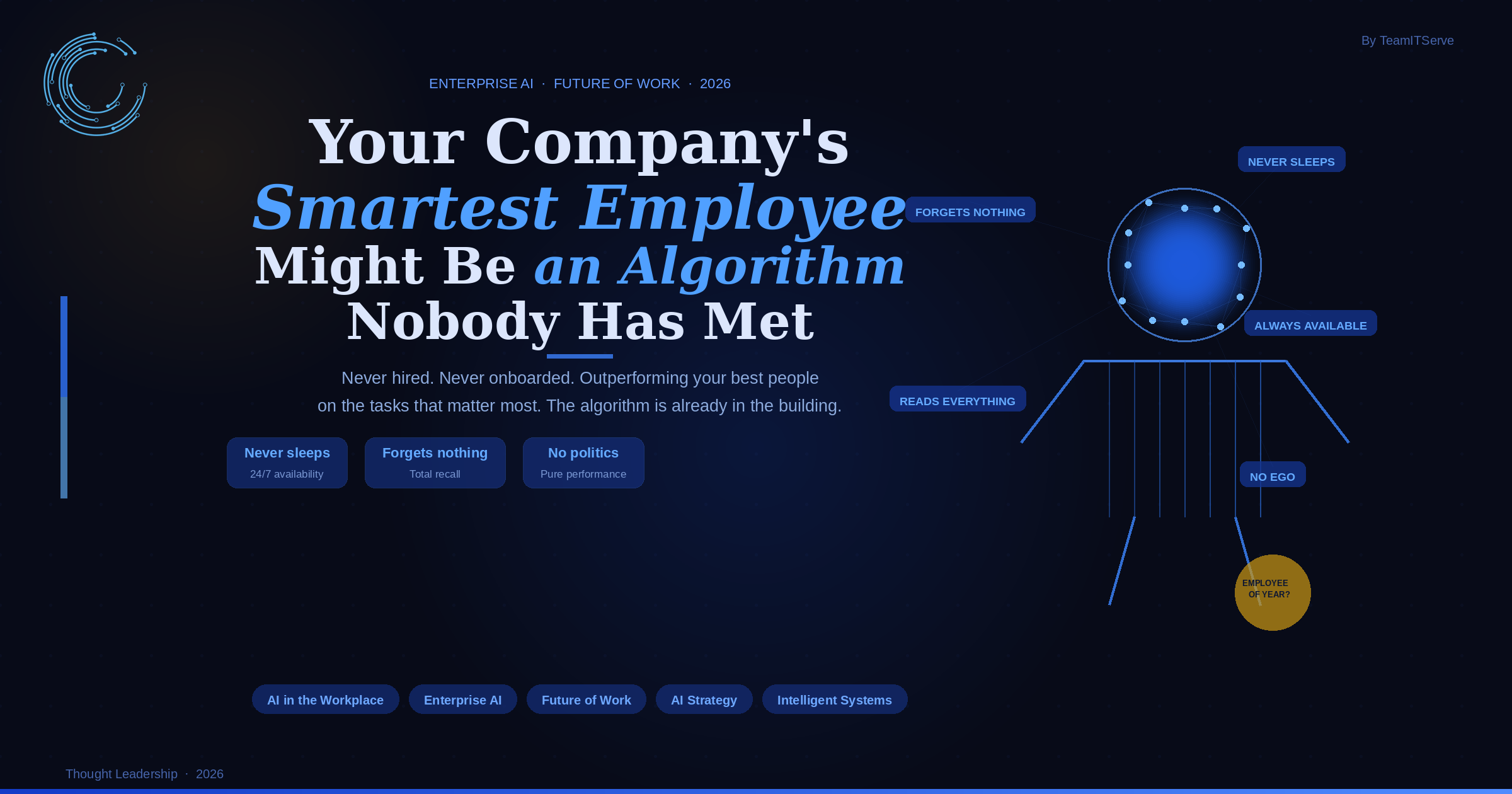
Nobody hired them. Nobody onboarded them. Most of the leadership team does not know they exist.
They are the AI system quietly running in the background — trained on your data, connected to your systems, improving with every interaction. And in a growing number of enterprises, they are outperforming the most experienced humans in the building on specific, high-stakes tasks.
Not in theory. In practice. Right now.
What This Actually Looks Like
A law firm in Chicago deployed an AI system to review contracts. Within three months it was catching clause-level risks that junior associates — smart people with law degrees — were consistently missing under deadline pressure. Not because the associates were bad at their jobs. Because the AI never gets tired at 11pm, never has seventeen other documents open, and never skips a section because a senior partner is waiting.
A mid-sized logistics company built an AI demand forecasting system on top of five years of their own operational data. It is now outperforming the judgment of their most experienced supply chain manager on routine forecast accuracy — the manager who spent fifteen years developing intuition the AI absorbed in a few weeks of training.
A healthcare network’s AI triage system flags patient deterioration risk faster than the morning handoff briefing gets to the relevant doctor. The system has no ego about being right. It has no hesitation about escalating. It just reads the data and acts.
In each case the AI is not replacing the human. But it is outperforming them on a specific dimension that used to be considered the most valuable thing that person brought to work.
Why This Is Disorienting for Organisations
Humans have always been the most complex and capable resource inside any organisation. Strategy, judgment, creativity, relationships — these lived entirely with people. The systems and tools around them were just infrastructure.
That mental model is breaking.
When the algorithm produces better contract analysis than the associate, better demand forecasts than the manager, better risk flags than the briefing — the organisation has to confront something genuinely uncomfortable. The most valuable contributor in a specific domain might not be a person on the payroll.
Most companies have no framework for this. They have not thought about how to integrate algorithmic expertise with human expertise. They have not decided where AI judgment gets trusted independently and where a human must remain in the loop. They are running powerful systems under governance structures designed for a world where humans were always the smartest thing in the room.
The Organisations Getting This Right
The ones navigating it well are doing something specific. They are treating their AI systems the way great managers treat exceptional talent — identifying exactly what they are best at, giving them the conditions to perform at that level, and building human roles around complementing what the AI cannot do rather than competing with what it can.
The AI is brilliant at pattern recognition across enormous datasets, available at any hour, consistent under pressure, and incapable of politics. It is not brilliant at navigating ambiguity, building client relationships, making judgment calls with incomplete information, or knowing when the right answer requires breaking the pattern.
Design your organisation around that division and you get something genuinely powerful. Keep pretending the algorithm is just a tool like a spreadsheet and you are leaving significant capability on the table while competitors who understand this pull ahead.
The Question Worth Sitting With
If you mapped every high-value task inside your organisation and asked honestly — is a human or an AI system better at this right now — how many tasks would you be surprised by the answer?
Most leaders who do this exercise come out the other side with a very different view of where their real competitive advantage lives, and where they have been protecting legacy processes that no longer need protecting.
The smartest person in the building might not have a desk.