


Most hiring managers will not admit this openly, but many interviewers will tell you: they know within the first few seconds of your answer whether you actually work with AI or just talk about it. | AI Fluency
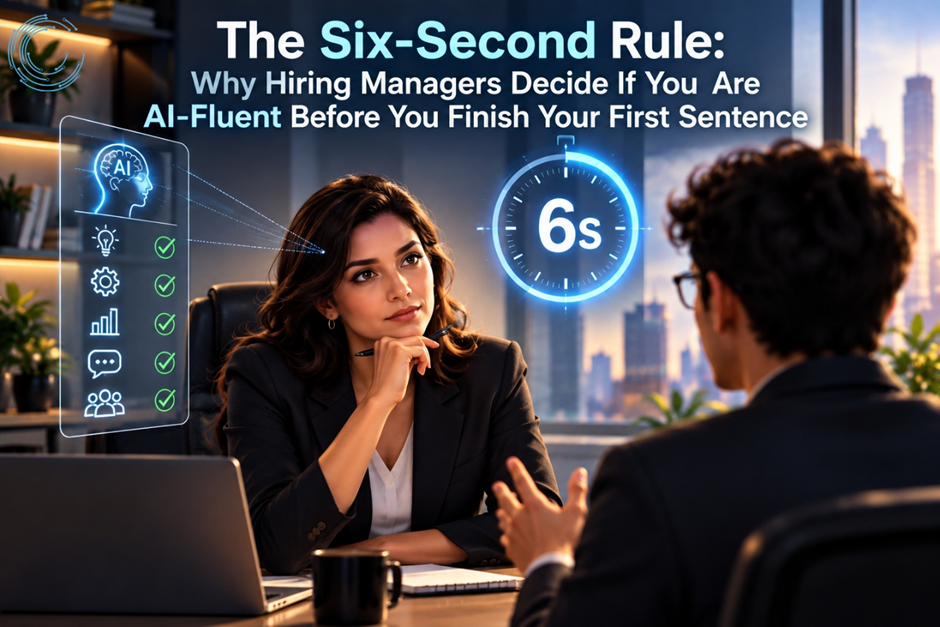
Not minutes. Seconds. Before you finish your first sentence, a judgment has already started forming.
Why the Decision Happens So Fast
Experienced interviewers have heard hundreds of answers to AI-related questions by now. The pattern recognition is instant. A rehearsed, generic opener — “I use AI tools to boost my productivity” — signals a scripted answer before any real content arrives. A specific opener — naming an actual tool, an actual task, an actual moment — signals the opposite immediately.
The six seconds are not really about speed. They are about specificity. The brain of an experienced interviewer detects genuine experience the same way it detects a rehearsed line, almost instantly, from word choice alone.
What Gives You Away in the First Sentence
Vague openers are the biggest tell. “I use AI a lot in my role” tells the interviewer nothing and signals a generic answer is coming. Buzzword openers — “I leverage AI-driven solutions to optimize workflows” — sound impressive and mean nothing, and experienced interviewers have heard this exact sentence structure hundreds of times.
The candidates who pass this instant filter start differently. They open with a concrete detail. “Last month I used an AI system to cut through eighteen months of unstructured customer feedback in one afternoon.” That sentence contains a timeframe, a scale, and an outcome — three things a rehearsed generic answer never has.
Why This Matters More Than It Seems
This is not really about AI at all. It is about whether a candidate can communicate with precision under pressure — a signal hiring managers have always cared about, now filtered through AI fluency as the topic.
A candidate who answers AI questions with specificity is demonstrating a broader skill: clear thinking under scrutiny. A candidate who answers with vague confidence is demonstrating the opposite, regardless of what the question happened to be about.
How to Win the First Six Seconds
Do not open with a claim. Open with a fact. Start your answer with a specific task, a specific tool, and a specific number if you have one. “I built a template that uses AI to draft the first pass of client proposals, cutting our turnaround from two days to same-day” lands completely differently than “I am very comfortable with AI tools.”
Practice your opening line specifically, out loud, before the interview. Not the whole answer — just the first sentence. That is the sentence doing the most work, and it is the one candidates prepare the least.
The six seconds are not a trick question. They are the moment where genuine experience and rehearsed talking points become instantly distinguishable — and now you know which side of that line to stand on.