


Many hiring managers have noticed the same shift over the past year, even if they have not said it out loud yet. The candidates who stand out are no longer necessarily the ones who can produce work fastest. They are the ones who can tell, quickly and reliably, when the work in front of them is wrong. | AI judgment
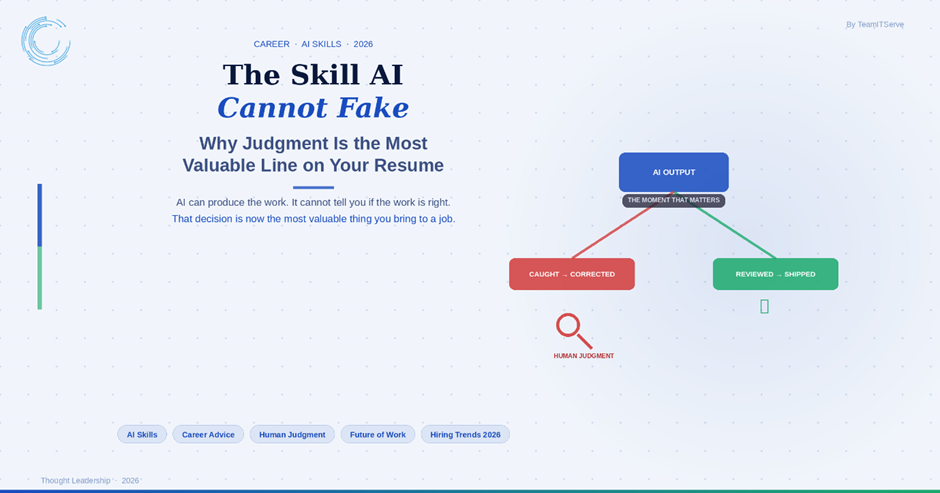
This is a genuine reversal. For most of the last century, output was the scarce resource in professional work. Writing the report, modeling the numbers, drafting the first version of anything — that took time and skill, and the people who could do it fastest and best were the most valuable hires.
AI has made that kind of output cheap. A competent first draft of almost anything can now take seconds. What has not gotten cheaper, and what is becoming an increasingly important differentiator in hiring and promotion decisions, is judgment — the ability to evaluate whether an output is actually correct, where it is likely to be wrong, and which decisions genuinely require a human to think them through before they go out the door.
Where This Shows Up in Practice
In finance, AI-generated market summaries and reports are increasingly common. The professionals who add real value are the ones who catch subtle errors before a client sees them — a misread time period, a figure pulled from the wrong context, or a conclusion that does not quite follow from the data presented. These errors are rarely obvious. They require someone who understands the domain well enough to notice when something looks slightly off, even when the output reads smoothly.
In healthcare administration, AI scheduling and resource allocation tools can produce recommendations that look efficient on paper but miss operational realities that only experienced staff would know — a handover window that looks redundant to an algorithm but is actually essential, or a staffing pattern that technically meets targets but creates a safety gap in practice. The tools are useful. The judgment about what to override is what can help prevent real problems.
In marketing and communications, AI-generated content is frequently polished and on-brand, yet it can miss cultural, regional, or brand-specific context that a generic model has no way of knowing. Catching that before publication is a judgment call, not simply a drafting task.
Across these examples, the AI can do competent, often impressive work. The value add comes from the evaluation step that follows.
How Hiring Is Adjusting to Reflect This
Interview questions are also evolving. Instead of asking candidates only to demonstrate familiarity with AI tools, some hiring managers ask candidates to describe a specific instance where an AI output was incorrect and how they identified the error. Questions like this can help distinguish candidates who have used AI tools seriously and critically from those who have used them only superficially.
Some employers are starting to build this into their assessment processes, deliberately introducing an error into AI-assisted work to see whether a candidate catches it before submission. This can be an effective way to test for a skill that is otherwise difficult to evaluate through a resume alone.
Why This Matters Most in High-Stakes Roles
The importance of judgment is particularly visible in domains where an incorrect output carries real cost — finance, healthcare, legal, compliance, and other regulated industries where accuracy has direct consequences.
It also matters in senior roles generally, because seniority has always been defined partly by the ability to exercise sound judgment under uncertainty. As AI absorbs more of the output layer of work, that judgment layer can become a larger and more visible part of what a senior professional contributes.
Building and Demonstrating This Skill
Professionals looking to strengthen this capability should treat every AI output as a starting point requiring verification, not a finished product. Developing a habit of actively looking for likely failure points — rather than only checking for obvious errors — builds the kind of pattern recognition that becomes genuinely valuable over time.
When discussing AI use professionally, the strongest framing emphasizes the evaluation process rather than simply the tools used. A specific example of an error identified and corrected demonstrates far more capability than a general claim of familiarity with AI systems.
The professionals who will be most valued over the next several years are not necessarily the ones who use AI the most. They are the ones who can be trusted to know when not to trust it.