


Two years ago, writing a clever prompt was treated as a career skill. Courses promised secret phrases, and job listings asked for prompt engineers. | Context Engineering
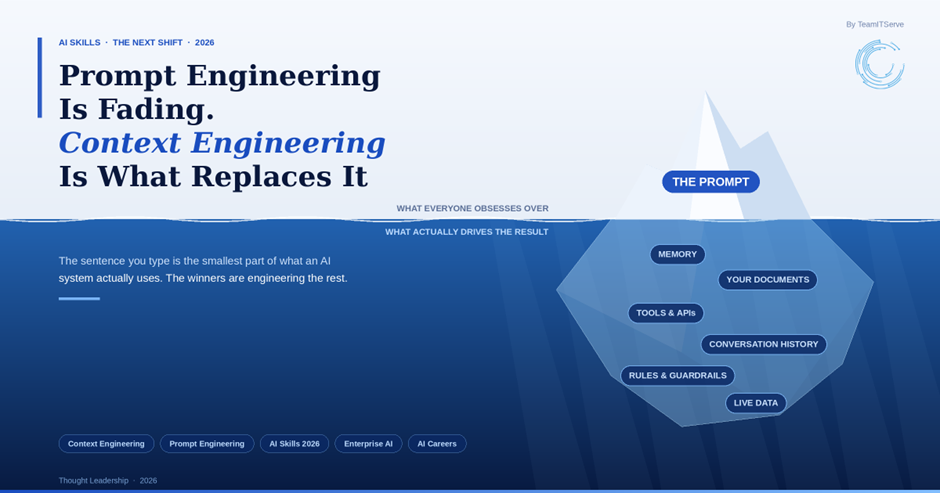
That era is ending. The sentence a person types into an AI system is now the smallest part of what determines the quality of the answer. What matters is everything the model can see and use before it responds. That discipline is called context engineering, and it is quickly becoming the skill that separates strong AI projects from disappointing ones.
What Context Engineering Actually Means
A language model does not know your business. It only knows what is placed in front of it at the moment it answers. Context engineering is the work of deciding what goes there: which documents to retrieve, which past conversations to remember, which tools to make available, which rules to enforce, and which live data to pull in.
Think of a new employee on their first day. A brilliant hire given a one-line instruction will produce average work. The same person given the client history, the style guide, the approval rules, and access to the right systems will produce excellent work. The person did not change. The briefing did.
Why Prompts Alone Stopped Being Enough
Early AI use was simple. A person typed a question and read the reply. Today, AI systems run multi-step tasks, use software tools, and work across long projects. In that setting, a well-written prompt cannot carry the load. If the system retrieves the wrong document or forgets an earlier decision, no phrasing will rescue the result.
Most failures that teams blame on the model are really context failures. The model was capable. It simply was not given the right information.
Three Examples of How This Plays Out
A customer support team deployed an AI assistant that kept giving outdated return policies. The prompt was fine. The assistant was pulling from an old policy document that nobody had removed from its knowledge base. Fixing the source material solved the problem within a day, with no change to the prompt.
A finance team asked an AI to explain a drop in quarterly margins. The first answers were generic. After the team connected the assistant to the actual ledger data and added a short note defining how the company classifies costs, the explanations became specific enough to take to leadership.
A software team found that their coding assistant produced code that ignored internal standards. Instead of rewriting prompts, they added a short project rules file and access to the existing codebase. The output matched their conventions almost immediately.
What This Means for Your Career
The valuable skill is moving from wording to design. Professionals who understand what information an AI needs, where it lives, how fresh it must be, and what the system should never do are the ones teams are starting to rely on. Job titles are already shifting toward roles such as AI workflow designer and AI solutions architect, which sit close to this work.
The good news is that this skill rewards domain knowledge. Someone who understands how a legal, finance, or operations process really works is better placed to build useful context than a person who only knows prompt tricks.
What This Means for Business Leaders
When an AI pilot disappoints, ask a different question. Instead of asking whether the model is good enough, ask whether it has the right information, access, and rules. Audit the documents it relies on. Define what it should remember and what it should forget. Set clear limits on what it may act on without review.
Investing in context is usually cheaper than switching models, and the improvement tends to last longer.
The Bottom Line
Prompts will not disappear, but they are becoming a small input into a larger system. The organizations getting reliable results from AI are the ones treating context as something to design, test, and maintain.
The prompt is the tip of the iceberg. Context is the part below the waterline, and it’s what decides whether the project stays afloat.
Need professionals who know how to build AI systems that actually work? Talk to ITTechnica about your hiring needs, or explore our current openings.