


Artificial intelligence has moved beyond experimentation, but enterprise AI implementation remains a challenge for many businesses. Organizations are investing in Generative AI, machine learning, intelligent automation and AI-powered applications. While initial pilot projects can demonstrate promising results, turning those experiments into reliable, production-ready business solutions requires a much broader approach.
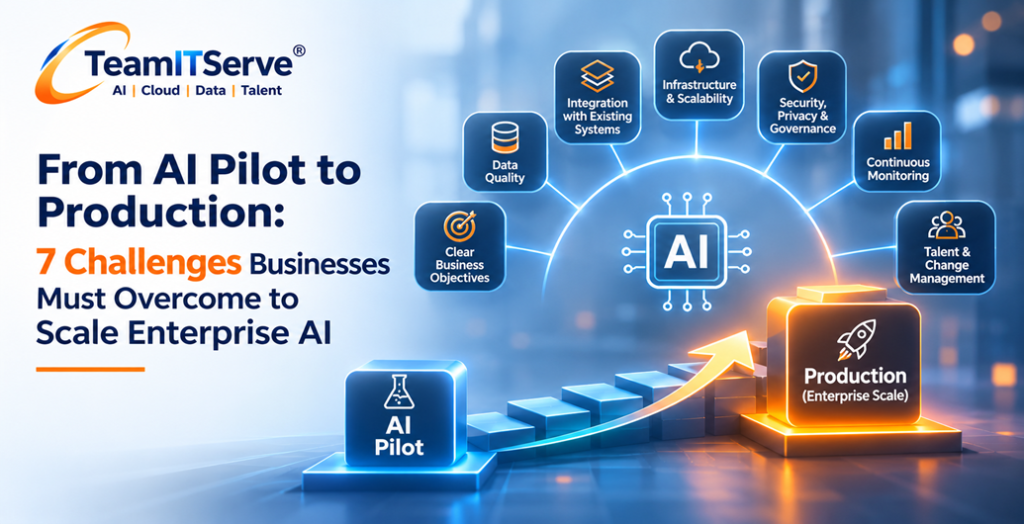
A pilot may work successfully with a small dataset, a limited number of users and a controlled environment. Production deployment is different. It requires dependable data, secure infrastructure, integration with existing systems, continuous monitoring and employees who understand how to work with AI.
According to McKinsey’s 2025 State of AI report, nearly two-thirds of surveyed organizations had not yet begun scaling AI across their enterprises. This highlights an important gap between experimenting with AI and realizing its value across the organization.
For businesses, the next challenge is not simply building another AI application. It is making AI work consistently, securely and at scale.
Here are seven major challenges businesses must overcome when moving from an AI pilot to production.
1. Unclear Business Objectives and Return on Investment
One of the most common mistakes in enterprise AI adoption is starting with technology instead of a clearly defined business problem.
Businesses may experiment with chatbots, predictive analytics or automated workflows because these technologies are gaining attention. However, without a specific business objective, it becomes difficult to determine whether an AI project is actually delivering value.
A successful pilot does not automatically translate into business results. Companies need to understand what they want to improve, how they will measure success and whether the solution can deliver measurable benefits when deployed across the organization.
Example:A company develops an AI chatbot to answer employee questions. During testing, the chatbot performs well. However, management has not defined whether success means reducing support tickets, improving response times or lowering operational costs. Once the pilot ends, the business has no clear way to justify a larger investment.
How businesses can overcome it:Start with measurable business outcomes. Define specific KPIs such as reduced processing time, fewer manual errors, improved customer response times or lower operational costs. Establish a baseline before deployment and compare results after implementation.
AI should solve a business problem, not become another technology project without a clear purpose.
2. Poor Data Quality and Fragmented Data Systems
AI systems depend on data. Even advanced models can produce unreliable results when the information they receive is incomplete, outdated, inconsistent or inaccurate.
In many organizations, business information is distributed across multiple systems, including CRM platforms, ERP software, spreadsheets, databases and internal document repositories. These systems may use different formats and maintain separate records.
During a pilot, developers can manually select and clean a limited dataset. Production systems must handle much larger volumes of information while maintaining accuracy, consistency and appropriate access permissions.
Example:A retail company wants to build an AI-powered inventory forecasting solution. Its sales records, warehouse data and supplier information are maintained in separate systems. If these datasets are not properly integrated, the AI model may generate inaccurate demand forecasts and recommend incorrect inventory levels.
How businesses can overcome it:
- Audit existing data sources before development.
- Remove duplicate and outdated records.
- Establish clear data ownership and governance policies.
- Create reliable data pipelines between systems.
- Implement appropriate access controls and data validation.
- Monitor data quality as information changes.
For Generative AI applications, businesses can also consider Retrieval-Augmented Generation (RAG) to connect language models with relevant enterprise information. However, RAG does not automatically solve poor data quality; the underlying documents and retrieval processes still need to be managed carefully.
A dependable data foundation is essential for scalable enterprise AI.
3. Integration With Existing Business Systems
An AI solution may perform perfectly as a standalone application but struggle when connected to the systems employees use every day.
Enterprise environments often include legacy applications, cloud platforms, databases, internal tools and third-party services. Connecting an AI solution to these systems requires careful planning around APIs, data formats, authentication, permissions and workflow dependencies.
Without proper integration, employees may need to move information manually between applications, reducing the value of automation.
Example:A customer support team introduces an AI assistant that can generate responses to customer queries. However, the assistant cannot retrieve order details from the company’s CRM or update support tickets. Employees still have to switch between applications to complete each request.
How businesses can overcome it:Plan integration requirements before moving a pilot into production. Identify the systems the AI application must communicate with, establish secure API connections and test how information moves between applications.
Businesses should also consider reusable integration patterns rather than developing separate connections for every new AI project.
The objective is to make AI part of existing business workflows, not create another disconnected tool.
4. Infrastructure and Scalability Limitations
A pilot usually operates under controlled conditions. It may serve a small group of users, process limited data and run on temporary infrastructure.
Production environments face different demands. More users, higher request volumes, larger datasets and real-time processing requirements can place significant pressure on infrastructure.
Businesses must also consider latency, computing costs, cloud resource availability, storage requirements and application reliability.
An architecture that works for a demonstration may become expensive or unstable when usage increases.
Example:A financial services company tests an AI-powered document processing application with a small internal team. The system works well during the pilot. After deployment across multiple departments, document volumes increase significantly, causing slower processing and higher infrastructure costs.
How businesses can overcome it:
- Design infrastructure around expected production workloads.
- Evaluate cloud, on-premises and hybrid deployment options.
- Use scalable computing and storage resources.
- Introduce load testing before wider deployment.
- Monitor application performance and infrastructure costs.
- Build backup and recovery mechanisms.
Businesses should scale infrastructure according to actual requirements rather than overinvesting in resources before they are needed.
5. Security, Privacy and AI Governance
Security becomes more important when AI systems begin processing sensitive business information or interacting with enterprise applications.
Production AI may handle customer records, employee information, financial documents, intellectual property and confidential business data. If access controls and governance policies are inadequate, organizations can expose information or allow unintended system actions.
Generative AI introduces additional considerations, including prompt injection, inaccurate outputs, data leakage and inappropriate use of AI-generated recommendations.
Example:A company deploys an internal AI assistant connected to its document repository. An employee asks for information about a confidential project. If the assistant does not respect the employee’s existing document permissions, it could expose information that the employee should not access.
How businesses can overcome it:
- Apply role-based access controls.
- Protect sensitive information through appropriate encryption.
- Establish clear AI usage and data handling policies.
- Test applications for prompt injection and other AI-specific risks.
- Require human approval for sensitive or high-impact actions.
- Maintain audit logs and monitor system activity.
- Review compliance requirements before deployment.
Security and governance should be included from the beginning of AI development rather than treated as final deployment checks.
6. Lack of Continuous Monitoring and Maintenance
AI deployment is not the end of the development process. Production systems need continuous monitoring to ensure they remain accurate, reliable, secure and cost-effective.
Data changes, business requirements evolve and user behaviour shifts over time. Models may experience performance degradation, while changes to APIs, infrastructure or connected applications can affect the overall solution.
Without monitoring, organizations may not identify problems until users begin experiencing them.
Example:An e-commerce business deploys a machine learning model to recommend products. Initially, recommendations are relevant and engagement improves. Over time, customer preferences and product availability change. Without monitoring and regular evaluation, the recommendation system may continue suggesting products that are no longer relevant or available.
How businesses can overcome it:
- Track model accuracy and output quality.
- Monitor response times and application availability.
- Identify changes in incoming data.
- Review user feedback and reported issues.
- Monitor infrastructure usage and operating costs.
- Test updates before deploying them.
- Maintain version control and rollback procedures.
MLOps and LLMOps practices can help businesses standardize deployment, evaluation, monitoring and maintenance across AI applications.
Production AI should be treated as a continuously managed business system, not a one-time software release.
7. Talent Gaps and Resistance to Organizational Change
Technology alone cannot make enterprise AI successful. Businesses also need professionals who can develop, integrate, secure and maintain AI solutions.
Many organizations have limited internal experience in areas such as machine learning engineering, Generative AI, data engineering, cloud infrastructure, RAG development and AI governance.
There is also a human challenge. Employees may be unfamiliar with AI-powered workflows or concerned about how new systems will affect their responsibilities. If employees do not understand how to use the technology, adoption can remain low even when the solution works technically.
Example:A manufacturing company introduces an AI-powered predictive maintenance system. The application identifies potential equipment problems, but maintenance teams continue relying on their existing processes because they have not received sufficient training or guidance. As a result, the company does not fully benefit from the new system.
How businesses can overcome it:Invest in both technical expertise and employee readiness. Identify the skills required to build and maintain the solution, provide training for employees and involve business teams throughout development.
Organizations can also work with experienced AI/ML consultants and engineering teams when internal capabilities are limited.
The goal is not simply to introduce AI tools. It is to help people use them effectively within their existing responsibilities.
How Businesses Can Build a Successful Enterprise AI Implementation Strategy
Overcoming these challenges requires a structured approach. Instead of moving directly from a successful demonstration to a company-wide rollout, businesses should follow a phased implementation strategy.
Step 1: Identify the right use case. Select a business problem with measurable value, realistic technical requirements and a clear owner.
Step 2: Evaluate data and infrastructure readiness. Review data quality, availability, integrations, security requirements and existing technology limitations.
Step 3: Develop a production-ready architecture. Plan how the AI application will connect to business systems, support users and scale as demand increases.
Step 4: Establish security and governance. Define access controls, human oversight, monitoring requirements and accountability before deployment.
Step 5: Test under realistic conditions. Evaluate performance using representative data, actual workflows and expected production workloads.
Step 6: Deploy gradually and monitor results. Start with a controlled group of users, collect feedback and expand deployment as the solution demonstrates reliability and business value.
This approach helps organizations reduce implementation risks while building a foundation that can support future AI initiatives.
How TeamITServe Can Help Businesses Move From AI Pilots to Production
At TeamITServe, we focus on helping businesses explore and implement technology solutions that address practical business requirements.
Moving AI from experimentation to production requires a combination of technical expertise, business understanding and a scalable implementation approach.
Our areas of focus include:
AI and Machine Learning:Developing intelligent applications and predictive solutions around business requirements.
Generative AI:Building AI-powered applications that support business information access, content workflows and productivity.
RAG Solutions:Connecting language models with relevant enterprise data to support context-aware responses.
Agentic AI:Exploring AI agents that can coordinate tasks and interact with business systems under appropriate controls.
Cloud and Engineering:Supporting the infrastructure, integration and engineering requirements of enterprise applications.
Whether a business is evaluating its first AI use case or looking to expand an existing implementation, the priority should remain the same: build solutions that are reliable, secure, scalable and aligned with business objectives.
Final Thoughts
Moving from an AI pilot to production is one of the most important steps in enterprise AI adoption. A successful demonstration can prove that a technology works, but a production-ready solution must deliver consistent results in real business environments.
Data quality, integration, infrastructure, security, monitoring, talent and measurable business objectives all contribute to long-term success.
Businesses that address these challenges early are better positioned to turn AI experimentation into meaningful operational improvements.
The future of enterprise AI will not be defined by how many pilots businesses launch, but by how effectively they turn those pilots into solutions that work.
Looking to move your AI initiative beyond the pilot stage? Connect with TeamITServe to explore AI/ML, Generative AI, RAG and Agentic AI solutions for your business.
Visit www.teamitserve.com to learn more.
Frequently Asked Questions
1. Why do enterprise AI projects fail to move from pilot to production?
Enterprise AI projects often struggle because of poor data quality, integration limitations, unclear business objectives, security concerns, infrastructure costs and a lack of ongoing technical support. A successful pilot does not automatically address these production requirements.
2. What is required to scale AI across an enterprise?
Businesses need reliable data, scalable infrastructure, secure integrations, clear governance policies, continuous monitoring and skilled professionals. They also need measurable business objectives and employee adoption plans.
3. How long does it take to move an AI pilot into production?
The timeline depends on the complexity of the use case, data readiness, integration requirements, security reviews and infrastructure. A relatively simple application may move to production faster than an enterprise-wide system connected to multiple business platforms. Organizations should prioritize readiness and reliability over rushing deployment.
4. What is the role of AI consultants in enterprise AI implementation?
AI consultants can help businesses identify suitable use cases, evaluate technical requirements, design AI architectures, integrate enterprise systems and establish deployment and monitoring practices. They can also help organizations access specialized engineering expertise when internal resources are limited.
Visit www.ittechnica.com to learn more.