


Eighteen months ago every serious AI conversation in a boardroom started the same way. | AI workflow strategy
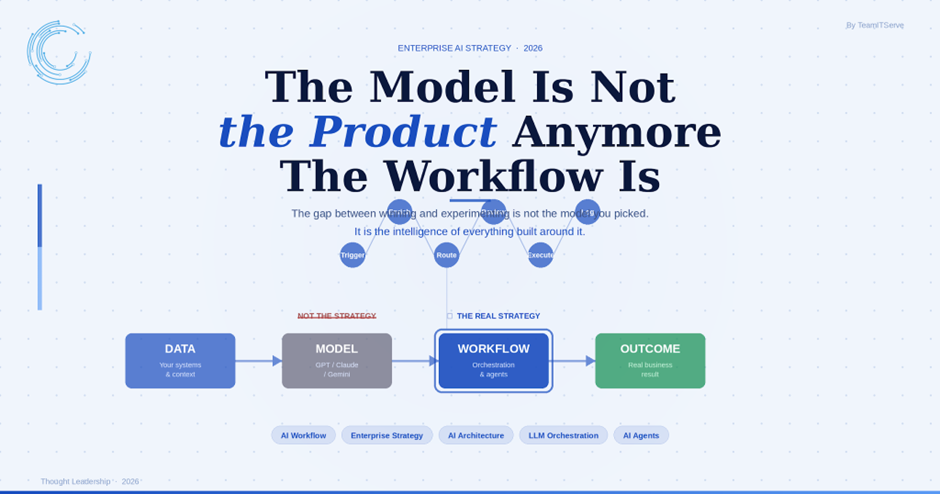
GPT or Claude? Gemini or Llama? Which model do we build on?
Teams ran benchmarks. Consultants wrote comparison decks. CTOs lost sleep over picking the wrong foundation. The model selection felt like the most consequential decision in the room.
It is not anymore. And the companies still treating it that way are solving the wrong problem.
What Actually Happened to the Models
The top AI models have converged. Not completely, not in every dimension — but enough that the practical difference for most business use cases is marginal.
Run the same enterprise task through GPT-4o, Claude, and Gemini today and the outputs are closer than they have ever been. The capability gap that made model selection a high-stakes decision in 2023 has narrowed to the point where it is rarely the determining factor in whether an AI deployment succeeds or fails.
What is determining success is everything around the model. The plumbing nobody talks about in the benchmark comparisons.
The Workflow Is Where the Value Lives
Think about what actually happens between a user request and a useful business outcome.
The model receives input. But where does that input come from — a clean prompt or a messy real-world trigger from another system? The model produces output. But where does that output go — a chat window or directly into a CRM, a database, a downstream workflow? Who reviews it? What happens when it is wrong? How does the system improve over time?
None of that is the model. All of it determines whether the deployment creates real value.
A mid-market logistics company switched from one leading model to another last year and saw almost no change in output quality. Then they rebuilt the workflow around it — connecting it properly to their inventory system, adding a human review step for exceptions, building feedback loops that flagged errors back into the process. Operational efficiency jumped 34 percent. The model was the same category of tool. The workflow was completely different.
That is not a model story. That is an architecture story.
Why This Shift Is Happening Now
Three things have made the workflow the battleground.
Models are available as commodities. Every serious model is accessible via API. Switching costs are lower than they have ever been. If a better model comes out tomorrow, a well-architected workflow can swap the underlying model in days. A poorly architected one cannot.
Data integration is the hard part. Getting a model to sound smart is easy. Getting it to act on your actual business data — your CRM, your ERP, your proprietary knowledge base — in real time, reliably, with proper governance, is genuinely difficult. That integration work is where most deployments either succeed or quietly collapse.
Agents orchestrated everything. When AI moves from answering questions to executing multi-step workflows autonomously, the model is one component in a larger system. How those components connect, hand off, and recover from errors is the entire engineering challenge. The model is almost incidental.
What the Winners Are Actually Building
The enterprises pulling ahead in 2026 are not the ones who picked the best model. They are the ones who built the most intelligent layer around it.
That means connected data pipelines that give AI the right context at the right moment. It means agent orchestration that handles handoffs without losing state. It means monitoring and feedback systems that catch errors before they compound. It means governance frameworks that scale as the workflow touches more of the business.
None of this shows up in a benchmark. All of it shows up in business outcomes.
The Strategic Implication
If your AI strategy is still primarily a model selection conversation, it is already a quarter behind.
The right question is not which model you are using. It is how well your workflows are built around it. Whether your data is connected. Whether your agents are orchestrated. Whether your system gets smarter over time or resets every morning.
The model is infrastructure now. Like choosing a cloud provider — it matters, but it is not the strategy.
The workflow is the strategy. The companies that understand that earliest will be the ones competitors are trying to catch up to in two years.