

The End of the Keyboard: Future of Human-Computer Interaction
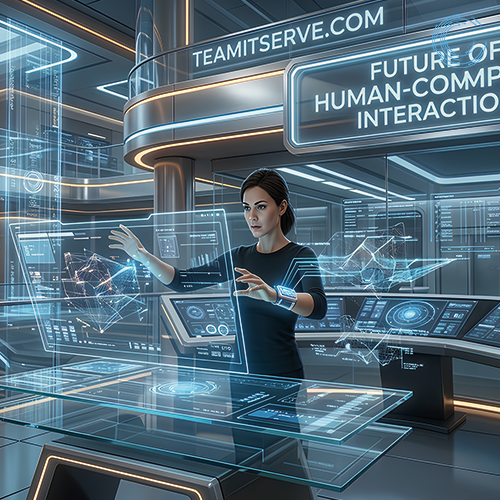
For fifty years, the keyboard was the handshake between humans and computers. You typed, and it responded. That simple contract held through mainframes, personal computers, smartphones, and the cloud. | human computer interaction In 2026, that contract is being rewritten. Something Shifted — and It Was Not Gradual The signs had been building for years: voice assistants that actually worked, touchscreens replacing physical buttons, and gesture controls in gaming. But these felt like additions, not replacements. What changed recently is the convergence. Voice, gesture, spatial computing, and brain-computer interfaces are no longer separate experiments. They are arriving together in real-world products—at a pace enterprises have not fully caught up with. Voice Grew Up Early voice interfaces were mostly novelty features. You could ask for the weather or set a timer, but frustration was common, and many users gave up quickly. That era is over. Large language models have transformed voice from a simple lookup tool into a reasoning layer. You can now speak naturally—using incomplete, contextual sentences—and the system understands your intent, not just keywords. Tools like Microsoft Copilot, now integrated across Office and Windows, are already enabling voice-driven workflows. Users can draft documents, search across systems, and summarize meetings in real time—without touching a keyboard. Gesture and Spatial Input Are Here Apple Vision Pro helped bring spatial computing into practical use, especially for early enterprise adopters. By 2026, newer devices are becoming lighter, more affordable, and more accessible. The interaction model is completely different. You look at something to select it. You pinch to confirm. You move your hands to interact. There is no mouse, touchpad, or keyboard involved. For industries like surgery, engineering, architecture, and field operations, this is more than a novelty—it is a better way to work. A surgeon can navigate imaging data using eye movement and gestures during a procedure. An engineer can walk around a 3D model in mixed reality and spot issues that a flat screen might miss. Thought as Input — No Longer Fiction In 2025, Neuralink received regulatory clearance for broader use of its brain-computer interface. A paralyzed individual was able to browse the internet, play chess, and send messages using only their thoughts. This is still early. The technology is invasive, and mass adoption is not expected anytime soon. However, non-invasive alternatives are already in development. These include headbands that read neural signals, eye-tracking systems combined with intent prediction, and EMG wristbands that detect muscle signals before movement. The question is no longer if thought-driven input will arrive—it is when it becomes practical enough to matter. What This Means for Everyone in IT Most applications, products, and workflows today are built around the keyboard and mouse. That assumption is now changing. Accessibility improves when input is not limited to typing. Productivity increases when your hands are free. Security models will also need to evolve as voice and biometric signals become part of authentication. Organizations that are paying attention now are not chasing trends—they are preparing. They are making sure their systems can adapt as the input layer evolves. The Shift Is Already Here The keyboard is not disappearing overnight. But for the first time in decades, it has real competition. And that competition is being developed by some of the largest technology companies in the world, with massive investment behind it. The key question for IT leaders, product teams, and developers in 2026 is simple:Are the systems you are building ready for a world where the keyboard is optional? Conclusion The way humans interact with machines is changing faster than most organizations expect. While the keyboard will remain relevant, it is no longer the default. Preparing for this shift now—by rethinking interfaces, workflows, and user experiences—will help businesses stay adaptable and competitive in the years ahead. TeamITServe helps enterprises understand and prepare for these technology shifts, from AI systems to the future of human-computer interaction. If your team is thinking about what comes next, this is exactly the conversation we are built for.
The End of the Keyboard: Future of Human-Computer Interaction Read More »