


Here is something nobody tells you when you deploy an AI system. | AI Memory Architecture
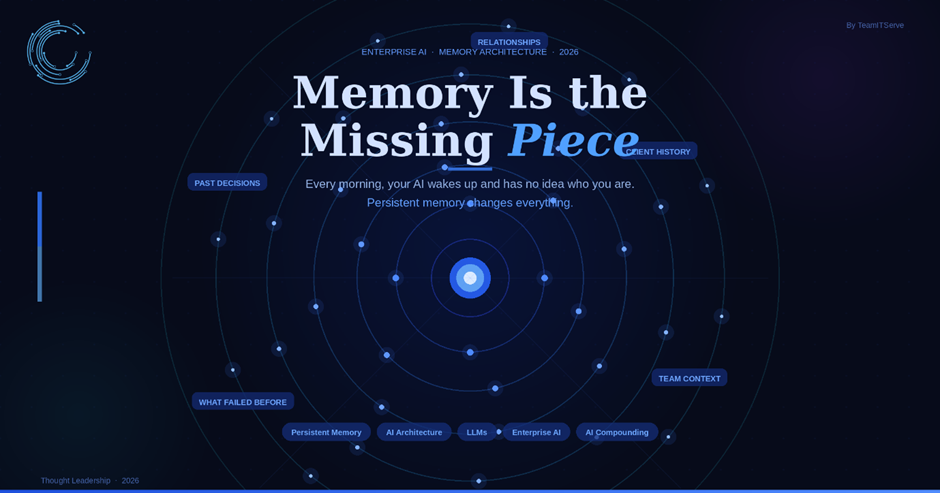
Every morning it wakes up and has absolutely no idea who you are.
It does not remember the strategy discussion from last week. It does not remember that a particular client is sensitive about pricing. It does not remember that your team tried an approach three months ago and it failed badly. It does not remember anything — because right now, almost every AI system in production resets completely between sessions.
You are essentially rehiring the same person every single day. And they start from zero every time.
Why This Is a Bigger Problem Than It Sounds
Think about what makes a great employee valuable over time. It is not just their raw capability. It is accumulated context. They know the history. They know the politics. They know what worked and what did not. They know the client’s name and what keeps them up at night.
An AI without persistent memory has none of that. It is permanently the new hire. Brilliant in a vacuum, frustratingly limited in practice.
This is why so many enterprise AI deployments plateau. The model is capable. The context is not there. And without context, capability only gets you so far.
What Is Actually Changing Right Now
Persistent memory in AI is one of the most actively developed capabilities at every major lab in 2026.
OpenAI rolled out memory features for ChatGPT that allow the system to retain user preferences and context across conversations. Anthropic is building long-context and memory capabilities directly into Claude’s architecture. A wave of startups — Mem, Zep, LangMem — are building memory infrastructure specifically for enterprise AI deployments, allowing systems to store, retrieve, and reason over information that accumulates over weeks and months.
The technical approach varies. Some systems use vector databases that store past interactions as searchable embeddings. Others use structured memory graphs that track relationships between people, decisions, and outcomes. Some combine both. The result in each case is the same — an AI that does not start from zero every morning.
What This Looks Like in Practice
A customer success team deploys an AI agent with persistent memory. Three months in, the agent knows every client’s history, preferences, past complaints, and renewal timeline. When a client emails in, the agent is not starting from scratch — it is responding with the full weight of the relationship behind it.
A legal team uses an AI research assistant that remembers every case it has helped with, every argument that succeeded, every precedent that was relevant. Six months in, it is not just fast. It is experienced.
An IT operations team runs an AI agent that monitors their infrastructure. Over time it learns what normal looks like specifically for their environment — not a generic baseline but their baseline. Its anomaly detection becomes sharper every week because it is building a picture, not just running isolated checks.
This is what AI compounding looks like. The system gets more valuable the longer it runs — like a great hire who grows into the role instead of resetting every Monday.
The Architecture Decision That Matters Now
Most enterprises have not thought about memory as an infrastructure question yet. They are evaluating AI tools on capability today without asking how that capability compounds over time.
The questions worth asking right now are straightforward. Does the AI system retain context between sessions? Where is that memory stored and who controls it? Can it be audited, corrected, or selectively cleared? Does it persist across users or only within individual conversations?
These are not advanced questions. They are the basics of building AI that actually grows in value rather than plateauing after the first month.
The Bottom Line
The gap between an AI that resets daily and one with genuine persistent memory is the gap between a capable tool and a genuine organisational asset.
The enterprises investing in memory architecture now are not just solving a technical problem. They are building something that compounds — context, knowledge, and judgment that accumulates over time and becomes genuinely hard for competitors to replicate.
That is not a feature. That is a moat.