


The US technology job market is doing something unusual right now. | AI Skills Gap
In a period where layoffs made headlines and hiring slowed across much of the industry, one category of professional is being actively recruited, significantly overpaid relative to market, and still undersupplied. Companies are competing for them. Recruiters are cold messaging them on LinkedIn within days of profile updates. Offers are coming with relocation packages, signing bonuses, and visa sponsorship that dried up in other parts of the market.
That category is professionals who understand AI at a practical, deployable level.
Not researchers. Not machine learning PhDs. Working professionals who can take AI tools, connect them to real business problems, build workflows around them, govern them responsibly, and explain what they are doing to a leadership team that does not have a technical background.
That person is rarer than the job postings suggest. And the gap between supply and demand is one of the most significant career opportunities in technology right now.
What US Employers Are Actually Paying For
The market has moved past the point where listing AI tools on a resume creates meaningful differentiation. Everyone lists them now. What employers are genuinely struggling to find — and paying premiums for — is something more specific.
Prompt engineering done at a professional level. Not casual prompting but structured, reproducible prompt design that produces consistent outputs across business workflows. This sounds simple. Very few people do it well at the level enterprises need.
AI workflow integration. The ability to connect an AI model to real business systems — a CRM, a database, an internal knowledge base — and build a workflow that actually runs reliably in production. This is part technical, part architectural, and heavily in demand.
AI governance and oversight. As enterprises deploy AI into consequential processes, someone needs to own quality control, output auditing, bias monitoring, and compliance documentation. This role barely existed two years ago. It is now a dedicated function at serious companies.
LLM application development. Building applications on top of large language models using APIs, frameworks like LangChain or LlamaIndex, and vector databases. The barrier to entry is lower than traditional software development. The demand is enormous.
AI project management. Running AI implementation projects requires understanding both the technology and the business change management that comes with it. People who can bridge that gap — technically literate but business fluent — are exceptionally hard to find.
The Roles That Did Not Exist Two Years Ago
Several job titles now appearing regularly in US hiring reflect how quickly this has moved.
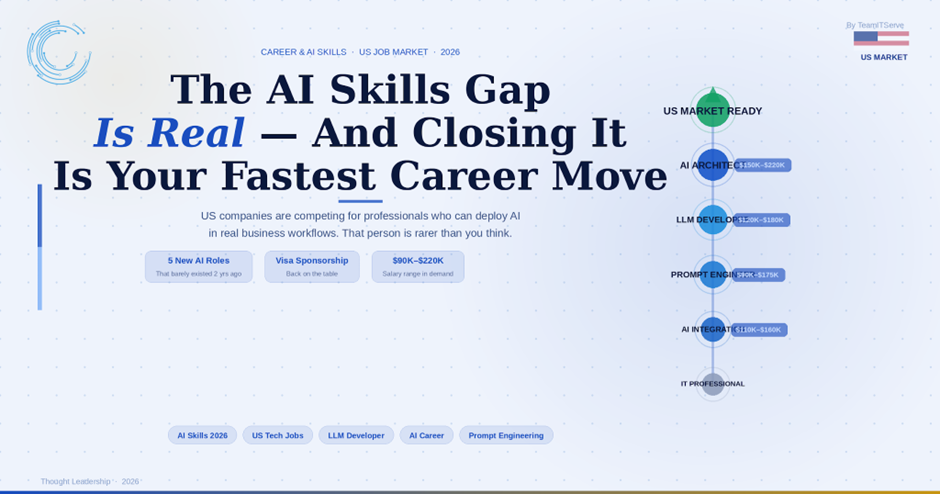
AI Integration Specialist. Sits between IT and business units, responsible for identifying where AI can be deployed and making it actually work in practice. Average US salaries for experienced candidates are running between $110,000 and $160,000.
Prompt Engineer. Dedicated role at larger companies focused on designing, testing, and optimising the instruction layer across AI deployments. Salaries range from $90,000 for junior profiles to over $175,000 at frontier AI companies.
AI Solutions Architect. Senior role designing the overall architecture of enterprise AI systems — how models connect to data, how agents are orchestrated, how governance is applied. One of the highest-compensating roles in the current market.
LLM Operations Engineer. Manages the infrastructure behind large language model deployments — latency, cost, reliability, monitoring. Borrows from DevOps but is specific to AI systems.
What Hiring Managers Say They Actually Want
The companies doing the most hiring in this space are consistently clear about what separates candidates who get offers from those who do not.
They want to see something built. Not a certification. Not a course completion. An actual project — a tool, a workflow, an application — that demonstrates you have connected AI to a real problem and made it work. GitHub repositories, personal projects, and freelance work all count.
They want business context. The candidates who stand out understand not just what the AI is doing technically but why it matters to the business. They can speak to ROI, to risk, to the change management involved in deploying AI into a team.
They want communication ability. AI implementations fail most often not because of technical problems but because the people deploying them cannot explain what is happening to the people using them. Clear, jargon-free communication about AI is a skill that is genuinely rare and genuinely valued.
The Honest Path Forward for IT Professionals
If you are an IT professional — in infrastructure, in development, in project management, in business analysis — the pathway into this market is more accessible than it appears from the outside.
The foundational technical concepts behind modern AI are learnable without a computer science degree. The frameworks being used in production are well-documented and actively maintained. The projects that impress hiring managers are not complex research implementations — they are practical tools that solve real problems using AI APIs that are publicly available.
The professionals making the fastest moves are spending three to six months building genuine hands-on experience — real projects, not just tutorials — and positioning themselves specifically for the integration and governance roles where business context and technical fluency combine. That combination is where the market is most underserved and where salaries are reflecting it most clearly.
The window where this creates maximum career leverage will not stay open indefinitely. As more professionals upskill, the premium will compress. The people who move in 2026 will be the ones who look back on this as the decision that defined the next decade of their career.
The Bottom Line
The AI skills gap is not a talking point. It is a measurable, documented shortage that US employers are actively trying to solve with compensation, visa sponsorship, and remote flexibility they have not offered in years.
The professionals who close that gap — practically, demonstrably, with real projects to show — are walking into one of the most receptive hiring environments the technology industry has seen in a long time.
The question is not whether the opportunity is real. It is whether you move on it before the window closes.