


Ask most CFOs how much their company spends on AI and you will get a confident number. Ask them how much their company actually spends on AI — including what every team, department, and individual employee has quietly signed up for — and the confidence usually disappears. | AI tool sprawl

This is not a hypothetical problem. It is happening inside a large percentage of mid-sized and large enterprises right now, and almost nobody at the top of the organisation has a clear picture of it.
How Fifty Tools Happens Without Anyone Deciding It Should
It rarely starts as a decision. It starts as a solution to a small problem.
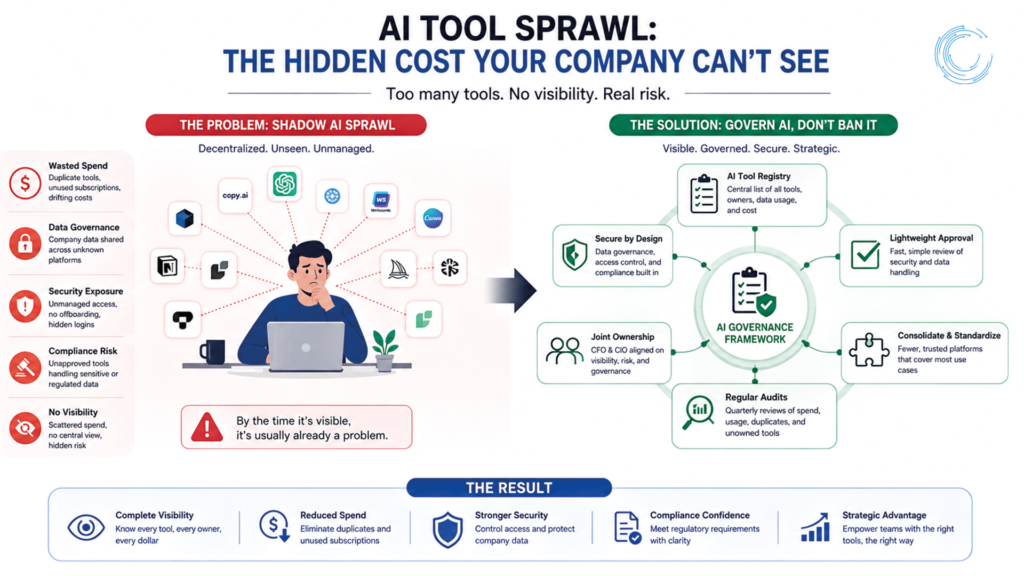
A marketing manager signs up for an AI writing tool on a company card to speed up campaign copy. A developer adds an AI coding assistant because it makes them faster and it was free to try. A support team lead pilots an AI chatbot on a departmental budget that never went through procurement because it was under the approval threshold. An HR coordinator starts using an AI tool for resume screening because a colleague recommended it.
None of these decisions were reckless. Each one made sense in isolation. But multiply that pattern across every team in a two hundred person company over eighteen months and you get exactly what enterprises are discovering now — dozens of AI tools running simultaneously, paid for through a scattered mix of expense reports, departmental budgets, and personal subscriptions, with no central visibility into any of it.
Why This Is a Bigger Problem Than Wasted Spend
The financial waste is real. Overlapping tools doing similar things, subscriptions nobody remembers signing up for, enterprise-tier pricing paid for by teams that only needed the basic plan. That adds up, and finance teams auditing this for the first time are often surprised by the total.
But the money is not the most serious issue. The real risk sits in three places most leadership teams have not fully confronted.
Data governance. Every one of these tools is a place company data goes. Customer information pasted into a chatbot for drafting help. Internal documents uploaded to a summarisation tool. Proprietary code shared with a coding assistant. Each tool has its own data policy, its own retention practices, its own security posture — and in most shadow AI situations, nobody has reviewed any of them.
Security exposure. Unmanaged tools mean unmanaged access. Nobody knows which former employees still have active logins to AI platforms that were never offboarded because IT never knew the account existed in the first place.
Compliance blind spots. In regulated industries, using an ungoverned AI tool to process customer data, financial information, or health records can create compliance exposure that the organisation does not even know it has taken on until an audit or an incident surfaces it.
Shadow AI is shadow IT’s successor, and it is spreading faster. Shadow IT took years to become a recognised enterprise risk category with established frameworks to manage it. Shadow AI has reached the same scale of risk in a fraction of the time, because the barrier to adopting a new AI tool is a browser tab and a credit card, not a lengthy procurement process.
Why Leadership Often Does Not See It Coming
The nature of shadow AI makes it structurally invisible to the people who should be managing it.
IT does not see it because most of these tools never go through IT. Finance does not see the full picture because the spend is scattered across dozens of small transactions rather than concentrated in a few visible vendor contracts. Leadership does not see it because the productivity gains are real and visible, while the accumulating risk is quiet and distributed.
By the time this becomes visible at the leadership level, it usually takes an incident — a data exposure, a failed audit, a discovery during a security review — rather than a proactive assessment.
What a Sensible Approach Actually Looks Like
The organisations getting ahead of this are not trying to ban AI tool adoption, which rarely works and pushes the behaviour further underground. They are building structure around it instead.
A central AI tool registry. A simple, actively maintained list of every AI tool in use across the organisation, who owns it, what data it touches, and what it costs. This alone solves most of the visibility problem and is far less effort than most leadership teams assume.
A lightweight approval pathway. Not a six week procurement process — a fast, simple review that checks data handling and security basics before a new AI tool gets adopted at scale. Fast enough that teams do not feel motivated to bypass it.
Consolidation around a core platform. Rather than fifty disconnected tools, the strongest organisations are standardising on a smaller number of well-governed AI platforms that cover the majority of use cases, with a clear, fast path to evaluate genuine exceptions.
Regular spend and usage audits. Quarterly reviews that surface duplicate tools, unused subscriptions, and spend that has drifted away from any clear owner.
The Conversation CFOs and CIOs Need to Be Having Together
This problem sits precisely between finance and technology, which is exactly why it often falls through the gap between them. Finance sees the spend without understanding the technical risk. IT sees the technical risk without visibility into the full spend. Neither has the complete picture alone.
The organisations solving this well have made it a joint conversation — CFO and CIO looking at the same registry, agreeing on the same governance framework, and treating AI tool sprawl as a shared risk rather than someone else’s problem.
The alternative is finding out the hard way exactly how many tools your company is running, exactly what they cost, and exactly what they have access to — usually at the worst possible moment to discover it.
TeamITServe helps enterprises build AI governance frameworks that bring visibility and control to AI tool sprawl — from spend audits to consolidation strategy. If you cannot currently answer how many AI tools your organisation is running, that is exactly where we start.