


Every enterprise seems to have an AI agent in production or in pilot right now. Fewer of them have a real answer to a simple question: how do you know it actually works.

Not “worked in the demo.” Works. Reliably. At scale. On the messy, inconsistent, unpredictable data that real business operations generate every day.
Most organisations cannot answer that question with confidence. And that gap is about to become very expensive for a lot of them.
Why Traditional Testing Does Not Translate
Software testing has a fifty-year foundation built on one core assumption: given the same input, the system produces the same output. Write a test case, run it, get a predictable result, verify it against the expected outcome. That is the entire model.
AI agents break that assumption completely.
Give the same agent the same prompt twice and it can produce two different responses. Not because something is broken — because that variability is inherent to how large language models work. The agent is not executing a fixed set of instructions. It is reasoning probabilistically, and probability means variation.
Traditional QA teams testing agents the way they test conventional software are essentially using the wrong instrument for the job. A test suite that passed yesterday can fail today with no code changes at all, simply because the underlying model behaved differently on a borderline case.
What Actually Goes Wrong in Production
The failures are not always dramatic. That is what makes them dangerous.
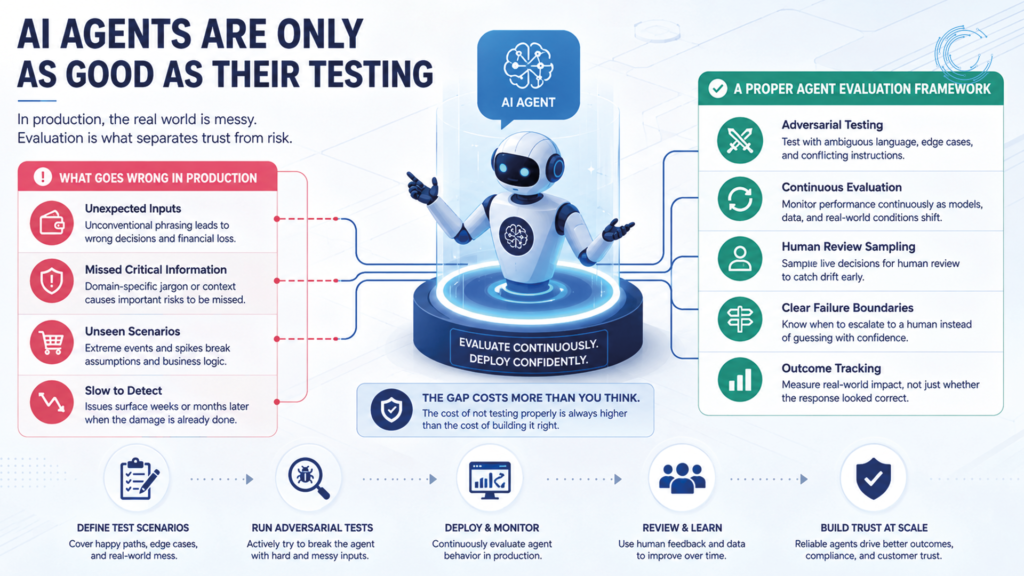
A customer service agent at a telecommunications company was tested extensively on common support scenarios before launch. It performed well. Three weeks into production, a customer described a billing issue using slightly unconventional phrasing — technically similar to test cases the team had run, but different enough that the agent misclassified the request and issued a refund it was never authorised to approve. Nobody caught it until the finance team noticed a pattern of unusual refunds weeks later.
A financial services firm deployed an agent to summarise client meeting notes and flag compliance-relevant statements. During testing, it caught every flagged phrase in the test set. In production, a client used industry-specific jargon that meant something different in context than the training examples suggested. The agent missed a compliance-relevant statement entirely. Nobody knew until an audit surfaced it months later.
A retail company’s inventory agent was tested against normal demand patterns and performed excellently. It had never been tested against a viral social media moment that spiked demand for one product by 40 times overnight. The agent’s reordering logic, built on assumptions that held in every test scenario, made decisions that made the shortage worse rather than better.
None of these failures happened because the underlying AI model was bad. They happened because the testing approach did not account for how differently agents behave once they meet the actual variability of the real world.
Why This Keeps Happening
Part of the problem is organisational pressure. Agent deployments move fast, driven by competitive urgency and leadership enthusiasm for visible AI wins. Testing frameworks, which are unglamorous and slow to build, get deprioritised in favour of shipping.
Part of the problem is genuine difficulty. Building a proper evaluation framework for an agent requires thinking about testing completely differently than most engineering teams are used to. You are not testing for a single correct output. You are testing for a distribution of acceptable outputs, edge case handling, and graceful failure when the agent encounters something genuinely outside its competence.
Most teams do not have that expertise yet. It is a genuinely new discipline, and the people who understand it well are in short supply.
What a Proper Agent Evaluation Framework Actually Looks Like
The organisations getting this right are building evaluation around a few core principles.
Adversarial testing, not just happy path testing. Instead of only testing scenarios where everything goes as expected, deliberately testing with ambiguous language, edge cases, conflicting instructions, and inputs designed to confuse the agent. If your test set only contains clean, well-formed examples, you are not testing for the real world.
Continuous evaluation, not one-time certification. An agent that passed testing in January is not guaranteed to behave the same way in June, especially if the underlying model gets updated or the data it encounters shifts. Evaluation needs to run continuously in production, not just before launch.
Human review sampling built into the process. Rather than assuming every output is correct, the strongest frameworks sample a percentage of live agent decisions for human review on an ongoing basis, catching drift before it becomes a pattern of failures.
Clear failure boundaries and fallback behaviour. The agent needs a defined answer for what happens when it is genuinely uncertain. The best systems are designed to recognise the edge of their own competence and escalate to a human rather than guessing confidently and being wrong.
Outcome tracking beyond output accuracy. It is not enough to check whether the agent’s response looked correct. Teams need to track what actually happened downstream — did the customer come back with the same issue, did the flagged compliance statement turn out to be a false positive, did the inventory decision play out well over the following weeks. Real evaluation happens after the agent has acted, not just when it produces an output.
The Uncomfortable Truth
Most organisations deploying AI agents right now are running an experiment in production and calling it a launch. The demo worked. The pilot looked promising. The rollout happened before the evaluation framework caught up to the ambition.
That gap is invisible until something goes wrong publicly enough to matter — a compliance failure, a customer-facing error, a decision that costs real money. By then the cost of not having built proper testing is far higher than the cost of building it would have been.
The enterprises that will avoid a painful agent failure story next year are not the ones moving slowest. They are the ones treating agent evaluation as seriously as they treat the agent’s capability itself.
TeamITServe helps enterprises build rigorous evaluation frameworks for AI agents — from adversarial testing to continuous production monitoring. If your agents have not been tested the way they need to be, that is exactly where we start.