


Think about the last time you thought about electricity. | Invisible AI

Not the bill. Not a power cut. Just electricity itself — the fact that it exists, that it is running through the walls, that it is powering the screen you are reading this on right now.
You did not think about it. You never do. And that invisibility is not a limitation of electricity. It is the proof that it works perfectly.
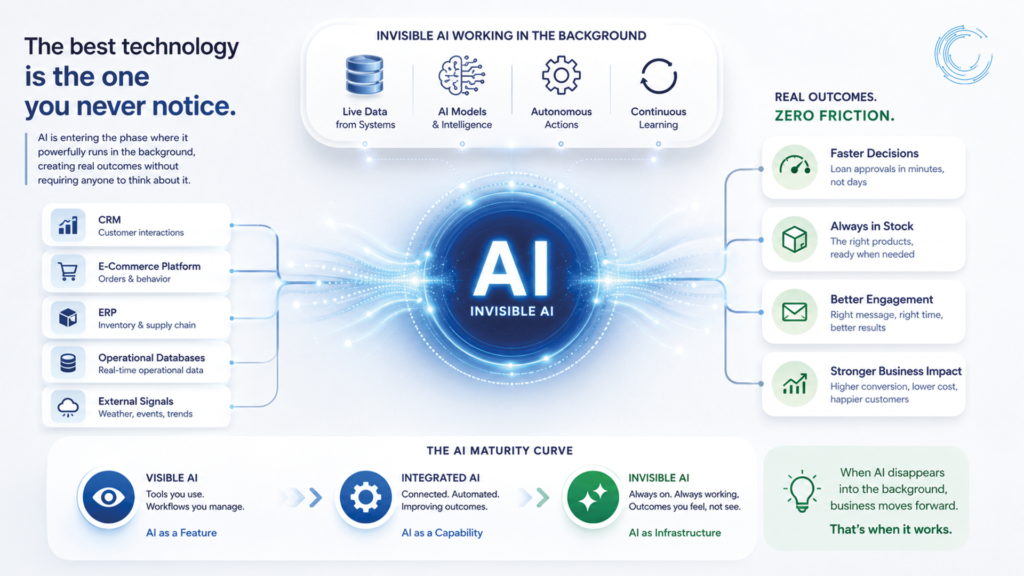
Every transformative technology follows the same arc. It starts to be visible, complicated, and requires conscious effort. Then it gets easier. Then it disappears into the background entirely — and that is when it becomes truly powerful. The internet went from something you dialled into to something that simply surrounds you. GPS went from a device on your dashboard to something you never think about because your phone already knows where you are going.
AI is entering that phase now. Not everywhere. Not for most organisations. But for the ones building it right, it is already happening.
What Invisible AI Actually Looks Like
A regional bank in the US processes loan applications faster than any competitor in their market. Customers notice the speed. Nobody notices the AI reviewing credit signals, flagging risk patterns, and pre-populating underwriter recommendations before a human opens the file. The AI is not the product. The fast loan is the product. The AI is just how it happens.
A global e-commerce company never runs out of its top fifty products. Operations managers do not think about inventory management anymore — the problem simply does not arise. Behind that absence of a problem is an AI system reordering stock based on demand signals, weather patterns, regional events, and supplier lead times. Nobody opens an AI dashboard. Nobody checks an AI output. The shelves are just always full.
A professional services firm sends proposals to prospects at a timing that consistently outperforms their industry benchmarks on open rates and response rates. Nobody on the team adjusted their outreach strategy. An AI system analysed thousands of past interactions, identified optimal contact windows for each prospect profile, and started routing sends automatically. The salespeople just notice that things seem to be going better.
In every case the AI is doing significant, consequential work. And in every case the people benefiting from it are barely aware it exists.
Why Most Enterprise AI Is Still Too Visible
If invisible AI is the goal, most enterprise deployments are nowhere near it.
Most AI in organisations today requires conscious activation. You open the tool. You type the prompt. You review the output. You copy it somewhere else. You repeat. This is useful — meaningfully useful in many cases — but it is not invisible. It is a workflow step. It still lives inside the human’s attention rather than outside it.
The reason is architectural. Most AI tools are built as interfaces — things you interact with. Truly invisible AI is built as infrastructure — something that runs continuously in the background, connected to real systems, acting on real data, producing real outcomes without requiring anyone to ask it to.
Building AI as an interface is faster and easier. Building it as infrastructure is harder, requires deeper integration, and demands a level of data quality and systems connectivity that most organisations have not achieved. But the gap in business impact between the two approaches is enormous.
The Architecture of Seamlessness
The organisations reaching invisible AI have built three things well.
Deep system integration. The AI is not connected to a data export or a weekly sync. It is connected to live systems — the CRM, the ERP, the customer platform, the operational database. It sees what is happening as it happens and can act on it in the same moment.
Defined autonomous authority. Someone has made a deliberate decision about what the AI is allowed to do without asking for permission. Not everything — but specific, bounded actions within specific, bounded contexts. The loan pre-assessment. The inventory reorder below a threshold. The email send within a defined window. That decision, made explicitly, is what allows the AI to act without requiring human activation every time.
Continuous feedback loops. The system monitors its own performance. When outcomes drift — when the inventory model starts missing, when the timing algorithm stops performing — it surfaces that signal automatically. Invisible AI is not unsupervised AI. It is AI that manages its own oversight rather than requiring humans to manage it manually.
The Maturity Test
Here is a useful way to think about where your organisation sits on this curve.
If someone asked your team to describe how AI is helping the business and the answer involves demonstrating a tool — opening it, showing what it does, explaining how to use it — your AI is still in the visible phase. It is a feature.
If the answer is instead a list of outcomes — faster decisions, fewer errors, higher conversion, lower churn — without any mention of a specific tool, your AI is approaching infrastructure. It is becoming invisible.
The organisations that will look back on 2026 as the year AI changed their business are not the ones that deployed the most impressive tools. They are the ones that made AI so embedded in how the business runs that it stopped being a thing anyone thinks about.
That is not the end state of AI adoption. It is the beginning of it actually working.