

TeamITServe

predictive analytics

From Data to Decisions: How Smart Companies Build AI That Actually Grows the Business

Most businesses sit on mountains of data and still make the same old guesses. (AI for Business Growth)The ones pulling ahead do not have better data—they have better decisions.And those decisions come from AI models built like precision tools, not science projects. Here is the exact playbook the winners follow to turn raw numbers into revenue. 1. Start with the Decision, Not the Data Every great model answer one question: “What do we need to know tomorrow that we’re guessing today?” Reduce churn by 15%?Lift average order value?Catch fraud before it happens?Cut excess inventory by millions? Pick the metric that moves the needle, then work backward.Everything else is noise. 2. Feed the Model What Actually Matters I have watched companies spend months cleaning every spreadsheet only to realize the real signal was hiding in call-centre notes and clickstream logs nobody touched. The best models feast on the messy, proprietary stuff nobody else has: That is the unfair advantage generic tools will never see. 3. Pick the Right Weapon for the Fight Classification for “will this customer leave?”Regression for “how much will we sell next Friday?”Sequence models for “what will this user buy next?”Vision transformers for defect detection on the factory line. Choosing the simplest model that solves the business problem beats chasing the fanciest architecture every single time. 4. Feature Engineering Still Beats Fancy Networks A telecom client once tried every new transformer under the sun to predict churn.Accuracy stayed stuck at 79%. One engineer added three features—days since last recharge, sudden drop in data usage, and whether the customer had called to threaten cancellation.Accuracy jumped to 88% overnight. The lesson?Better ingredients beat better recipes. 5. Test Like the Real World Is Watching (Because It Is) Cross-validation is table stakes.The real test is holding out the last three months of data and pretending it is next quarter. If the model falls apart on fresh data, ship nothing.If it still works when customers change their behaviour after Christmas, you have a winner. 6. Make the Model Part of the Furniture The fastest ROI I have ever seen came from a logistics company that pushed routing predictions straight into the driver app—no dashboard, no export, no human in the loop. Predictions that live in a weekly report change nothing.Predictions that change the next delivery route, the next price on the website, or the next email subject line change everything. 7. Treat Your Model Like a Living Thing Customer behaviour shifted hard after the 2024 election.Companies still running 2023 models woke up to 30% error rates. The winners retrain every week, watch for drift like hawks, and push updates before anyone notices the dip. Real Money, Real Examples A fashion retailer swapped a vendor recommendation tool for a custom model.Average order value rose 17%, repeat purchases jumped 28%, and the model paid for itself in ten weeks. A lender automated 60% of credit decisions with a model trained on their own messy approval notes.Underwriting time fell 40%, defaults dropped, and they approved 18% more good customers the old system would have rejected. A hospital flagged high-risk readmissions 72 hours earlier than before.Readmission rates fell 15%, saving lives and millions in penalties. The Truth Nobody Says Out Loud Building AI that actually grows the business is not about being cutting-edge.It is about being relentlessly focused on the decision that matters, feeding the model the truth nobody else has, and shipping something that changes behaviour tomorrow morning. Do that once and the next five models become obvious. That is how the quiet leaders turn data into decisions—and decisions into dominance. Ready to build the model that finally moves your most important metric?TeamITServe has done it for retailers, banks, hospitals, and logistics giants.Let us do it for you.

From Data to Decisions: How Smart Companies Build AI That Actually Grows the Business Read More »
Industry Specific AI Models

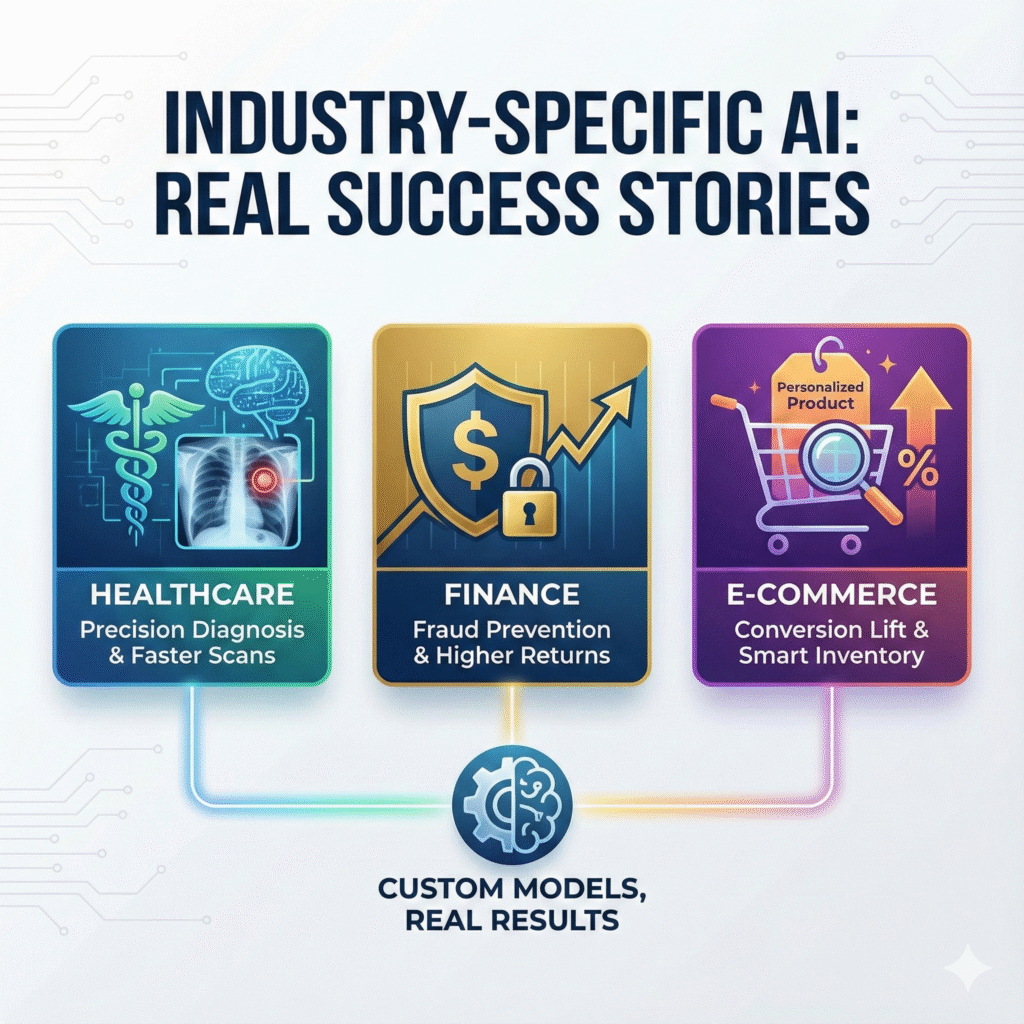
Industry-Specific AI Models: Real Success in Healthcare, Finance & E-commerce

Walk into any boardroom in 2025 and you will hear the same line: “We’re doing AI.” (Industry Specific AI Models)Then look at the results.The companies quietly pulling ahead are not the ones who bought the shiniest SaaS dashboard.They are the ones who built AI that speaks their industry’s language. Here is what happens when you stop forcing generic tools into specialized worlds and start building models that understand the job. Healthcare – When Seconds and Lives Are on the Line A top-tier hospital network was losing precious minutes on chest scans.The off-the-shelf radiology AI kept missing subtle nodules and flagging shadows that turned out to be nothing. They trained a custom deep-learning model on fifteen years of their own annotated scans, technician notes, patient outcomes, and even the quirks of their specific MRI machines. Outcome:The model now spots lung abnormalities 20% faster and cuts false negatives by 10–15%.Radiologists went from doubting the AI to refusing to read a scan without it. Another oncology centre built a recommendation engine that digests genetic profiles, trial data, and past treatment responses from their own patient cohort.Targeted therapy match accuracy jumped 30%, side effects dropped, and drug costs fell because the right treatment was chosen the first time. Finance – Where False Positives Cost Millions One of the largest U.S. banks used to freeze thousands of legitimate cards every weekend because the vendor fraud tool could not tell the difference between a vacation in Bali and a stolen card. They built their own anomaly model using device fingerprints, typing cadence, usual coffee-shop locations, even how far the customer normally drives on Sundays. False positives crashed 50%.Fraud losses dropped by millions a year.Customer complaints about blocked cards became a non-issue. A global hedge fund took it further.Their custom sequence-to-sequence neural network eats macro data, sentiment, order-book imbalance, and satellite imagery of crop yields.Annualized returns beat the benchmark by 13% with lower drawdowns than any commercial trading bot. E-commerce – Turning Clicks into Cash A mid-sized fashion retailer was stuck at 1.8% conversion with a popular plug-and-play recommendation widget. They replaced it with a model that watches what users linger on (but do not click), style-quiz answers, weather at the shipping address, and Instagram likes. Conversion rate hit 28% lift.Average order value rose 17%.The widget vendor still sends them renewal invoices they never open. Another marketplace trained a demand-sensing model on 40 million SKUs, competitor pricing, TikTok trends, and local events.Forecast error fell 35%, excess inventory costs dropped 22%, and for the first time in years they did not have to fire-sale summer dresses in September. The Pattern Nobody Talks About Every single winner above shares three things: Generic tools give everyone a fishing rod.Industry-specific custom models teach the fish to jump straight into your boat. Your Industry Is Next Whether you are predicting patient no-shows, fraudulent wire transfers, or the next viral hoodie colour, the playbook is the same: own your data, own your model, own your future. The companies winning today are not waiting for the perfect universal AI.They are building the perfect AI for their corner of the universe.

Industry-Specific AI Models: Real Success in Healthcare, Finance & E-commerce Read More »

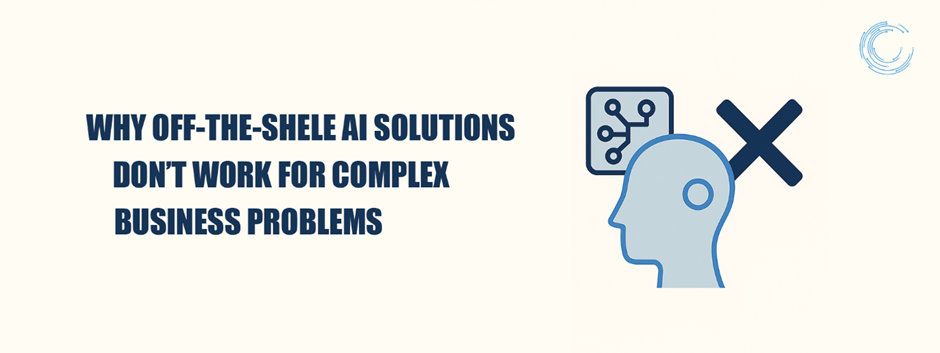
Why Off-the-Shelf AI Solutions Don’t Work for Complex Business Problems

In 2025, artificial intelligence (AI) is no longer a luxury—it is a cornerstone of business success. From streamlining operations to predicting customer preferences, AI empowers organizations to stay ahead in a competitive landscape. However, many businesses discover a hard truth: off-the-shelf AI solutions, while tempting with their promise of quick results, often fail to address complex, real-world challenges. Let us explore why generic AI falls short and how custom AI models deliver transformative value, with vivid examples that bring the difference to life. The Unique Nature of Every Business Every organization has its own fingerprint—distinct workflows, data sources, and customer behaviours. Off-the-shelf AI models, trained on broad, public datasets, are designed for general scenarios, not your specific context. Imagine a bank using a pre-built fraud detection tool trained on global transaction data. If local spending patterns differ, the model may flag legitimate purchases as fraud, frustrating customers, and costing revenue. A custom AI model, built on your company’s transaction history, adapts to these nuances, ensuring precision and trust. Rigid Frameworks Limit Integration Generic AI tools prioritize ease of use but often lack flexibility. They struggle to integrate seamlessly with your existing systems—be it data pipelines, CRM platforms, or IoT networks. Consider a logistics firm needing to optimize delivery routes in real time. An off-the-shelf tool might not sync with GPS, weather APIs, and internal dashboards, leading to delays and inefficiencies. A custom model, designed to pull these diverse data streams together, creates a smooth, end-to-end solution that feels like an extension of your operations. Complex Challenges Demand Tailored Solutions Many business problems are far from standard. Predicting equipment failures in a factory, optimizing production lines, or detecting subtle compliance risks requires AI that understands your specific datasets and goals. For instance, a hospital using a generic diagnostic tool might miss critical patterns unique to its patient population or imaging equipment. A custom neural network, trained on local data, can spot these patterns with precision, improving outcomes where off-the-shelf tools fall flat. No Competitive Edge with Generic Tools When every company uses the same pre-built AI, insights become predictable—and so do results. A custom AI model, however, is your secret weapon. Picture a retailer building a recommendation engine tailored to local buying habits and seasonal trends. Unlike a generic tool, it suggests products that resonate deeply with customers, creating personalized experiences that drive loyalty and sales. This level of differentiation sets you apart in a crowded market. Hidden Costs of Off-the-Shelf AI While generic AI seems cost-effective initially, hidden expenses pile up—licensing fees, usage caps, and costly workarounds to make the tool fit your needs. Worse, poor performance forces teams to adjust processes to suit the software, draining time and resources. Custom AI requires an upfront investment but pays dividends through accuracy, efficiency, and scalability, evolving into a long-term asset as your data grows. A Real-World Lesson: Retail Inventory Success Consider a mid-sized retailer that adopted a generic demand forecasting tool. It worked well for popular items but stumbled on niche products and regional trends, leading to overstocked shelves and missed sales. After switching to a custom AI model trained on their sales data, local weather patterns, and marketing campaigns, forecast accuracy improved by 32%. This meant less waste, better inventory decisions, and a noticeable boost in profits—a clear win that generic AI could not deliver. The Path Forward in 2025 Off-the-shelf AI can be a starting point for simple tasks, but complex business challenges demand more. Custom AI models, crafted for your data and goals, unlock true intelligence—driving smarter decisions, operational efficiency, and competitive advantage. In a world where data is the new currency, the companies that thrive are those building AI as unique as their vision. For more insights on tailored AI solutions, explore TeamITServe.

Why Off-the-Shelf AI Solutions Don’t Work for Complex Business Problems Read More »

Custom Neural Networks: Powering Business Success with Tailored AI

Imagine you are running an online store, and your recommendation engine keeps suggesting winter coats to customers in sunny Florida. Frustrating, right? Off-the-shelf AI models can miss the mark, but custom neural network architectures are here to change that. By designing AI tailored to your unique business needs, you can unlock smarter predictions, streamline operations, and stay ahead of the competition. Let’s dive into what custom neural networks are, why they matter, and how they can transform your business in 2025. What Are Custom Neural Networks? Think of a neural network as a digital brain that learns from data to make predictions or decisions. Unlike generic models like ResNet or BERT, custom neural networks are built from the ground up to tackle your specific challenges—whether it’s predicting customer churn, spotting fraud, or optimizing delivery routes. They’re designed to fit your data, goals, and constraints like a glove, balancing accuracy with efficiency. Real-Life Example: A logistics company built a custom neural network to predict delivery delays by blending weather, traffic, and route data. The result? Faster deliveries and happier customers. Why Go Custom? Custom neural networks give businesses a serious edge: Example: A healthcare clinic used a custom network to combine patient records and imaging data, catching early disease signs with accuracy that generic models couldn’t match. How to Build a Custom Neural Network Creating a custom neural network is like crafting a recipe—it takes the right ingredients and a clear plan. Here’s how it works: Step What It Means Define Your Goal Pinpoint the problem—e.g., forecasting sales or classifying customer feedback. Know Your Data Match your data type (text, images, numbers) to the right architecture, like CNNs for images or Transformers for text. From there, experiment with layers and settings, fine-tune with tools like Optuna, and test rigorously with cross-validation to ensure real-world reliability. Finally, deploy the model using platforms like AWS SageMaker for seamless integration. Real-World Wins Custom neural networks are already making waves: These examples show how custom AI delivers results that generic models can’t touch. Why This Matters in 2025 As data grows more complex, businesses need AI that’s as unique as they are. Custom neural networks turn raw data into powerful, tailored solutions—driving smarter decisions and bigger profits. Whether you are optimizing supply chains or personalizing customer experiences, custom AI is your ticket to standing out. Want to explore how custom AI can transform your business? Visit TeamITServe for more insights.

Custom Neural Networks: Powering Business Success with Tailored AI Read More »

Supervised vs Unsupervised Learning: Which One Fits Your Needs?

Artificial Intelligence (AI) and Machine Learning (ML) are revolutionizing businesses worldwide. From Netflix recommending your next show to banks detecting fraud, these technologies rely on two core approaches: Supervised Learning and Unsupervised Learning. But which one suits your business goals? Let us break it down in clear, simple terms, with practical business cases to show how each works and why it matters in 2025. What Is Supervised Learning? Imagine teaching a child to identify animals using flashcards. You show a picture of a cat and say, “This is a cat.” Then a dog: “This is a dog.” With practice, they learn to recognize cats and dogs independently. That is supervised learning—training an algorithm with labelled data, where the correct answers are already known. Practical Business Cases: Why It is Great: The Catch: What Is Unsupervised Learning? Now picture giving that child a pile of toys and asking them to sort them however they see fit—by colour, shape, or size. That is unsupervised learning—giving an algorithm unlabelled data and letting it discover hidden patterns or groupings on its own. Practical Business Cases: Why It is Great: The Catch: Which One Should You Choose? Your choice depends on your business objective: Many businesses use both together. For instance, a retailer might use unsupervised learning to identify customer segments, then apply supervised learning to predict which segments are most likely to buy a new product. Practical Business Case: A supermarket chain used unsupervised learning to categorize customers into groups like “health-conscious” or “budget shoppers,” then used supervised learning to predict which products each group would buy, increasing sales by 8%. Supervised and unsupervised learning are complementary tools, each with unique strengths. Supervised learning is your go-to for predicting clear outcomes with labelled data. Unsupervised learning uncovers hidden patterns when you are exploring without predefined answers. By aligning the right approach with your business goals, you can harness machine learning to make smarter decisions and stay competitive in 2025.

Supervised vs Unsupervised Learning: Which One Fits Your Needs? Read More »

Your Simple Guide to Custom AI/ML Models in 2025

Artificial Intelligence (AI) and Machine Learning (ML) are no longer just for tech giants—they are helping businesses like yours solve real problems. While ready-made AI tools are handy, custom AI/ML models are like a tailored suit: built just for you, using your data, to tackle your specific challenges. Here is a beginner-friendly guide to why custom AI matters, how it works, and what’s trending in 2025, with real-life examples to bring it to life. | custom AI ML models Why Build a Custom AI/ML Model? Off-the-shelf AI tools are like renting a car—they get you from A to B, but they are not yours. Custom models are designed for your business, giving you better results and a competitive edge. Why it is worth it: Example: A small coffee shop chain used a custom AI model to predict which drinks customers would buy based on weather and time of day. Sales jumped 15% because they stocked the right ingredients and ran targeted promotions. How to Build a Custom AI/ML Model Creating a custom model sounds complex, but it is just a few clear steps. Here is the process: 1. Know What You Want Start with a specific goal. Want to keep customers coming back? Predict inventory needs? Make your app feel more personal? Clear goals make everything easier. Example: A local gym wanted to reduce member cancellations. Their AI model analyzed workout patterns to spot who might quit and offered them personalized class suggestions. 2. Get Your Data Ready AI needs data to work—like customer purchases, website clicks, or even photos. The key is cleaning it up (removing errors) and organizing it so the AI can learn from it. Example: A bakery used sales records and customer feedback to train an AI model, helping them figure out which pastries to bake more of each day. 3. Pick the Right Model There are different types of AI models, like ones for predictions or image analysis. Experts choose the best one for your goal and test it to make sure it works. 4. Train and Test Your model learns from your data, like studying for a test. Then it is tested to ensure it can handle new situations without messing up. 5. Put It to Work Once ready, the model goes live—maybe in your app, website, or store systems. It needs to fit smoothly into how you already work. Example: An online retailer integrated a custom AI model into their website to recommend products based on what customers browsed. This boosted their average order value by 10%. 6. Keep It Updated Your business changes, and so should your AI. Regular updates keep it sharp as customer habits or markets shift. What’s New in AI/ML for 2025 Here are some exciting trends making waves: Why Custom AI/ML Is Your Next Step In 2025, custom AI/ML models are like hiring a superstar employee who knows your business inside out. They help you solve problems, save time, and grow smarter. Whether you are a small shop or a growing company, custom AI can make a big difference. At TeamITServe, we love helping businesses turn their data into solutions that work. Ready to take your business to the next level with custom AI? Let us make it happen!

Your Simple Guide to Custom AI/ML Models in 2025 Read More »

A Simple Guide to Building Custom Machine Learning Models for Your Business

In today’s fast-paced, data-driven world, collecting information is not enough—it is about turning that data into insights that help your business thrive. That is where custom machine learning (ML) models shine. Unlike generic AI tools, custom ML solutions are built specifically for your business’s unique challenges and goals, like a tool crafted just for you. Here is an easy-to-follow guide to creating and using custom ML models in 2025, with real-world examples to make it clear. 1. Start with a Clear Goal Before diving into data or tech, ask yourself: What problem do I want to solve? A clear goal keeps your project focused and ensures it delivers real value. Examples: Defining the goal in simple terms helps your ML model focus on what matters most. Real-Life Example: A local pet store used a custom ML model to figure out which products (like dog treats or cat toys) were most likely to sell based on customer buying habits. This helped them stock smarter and boost sales by 12%. 2. Gather and Clean Your Data Machine learning needs data to work—it is like the fuel for your model. The better the data, the smarter your model will be. You will need to: This step takes time, but it is the backbone of a great model. Real-Life Example: A café used customer purchase data and online reviews to train a model that predicted which menu items to promote each week, cutting food waste by 20%. 3. Pick the Right ML Type Not every problem needs the same kind of ML model. Here are the main types: Your team will choose the best type based on your goal and data. 4. Build, Train, and Test the Model Now it is time to create the model. Data experts will: The aim is a model that is accurate and ready for action. Real-Life Example: A fitness app used a custom ML model to recommend workout plans based on user activity. Testing ensured it worked for both beginners and pros, leading to a 15% increase in user engagement. 5. Put It to Work in Your Business A model is only useful if it fits into your daily operations. This means connecting it to your systems—like your website, app, or internal dashboards—so your team can use its insights easily. For example, it might send alerts about low stock or suggest customer deals in real time. Real-Life Example: A clothing retailer integrated an ML model into their e-commerce site to recommend outfits based on what customers browsed. This led to a 10% rise in average order values. 6. Keep Improving It Your business evolves, and so should your ML model. Regularly check its performance, update it with new data, and tweak it as customer habits or market trends change. Think of it like tuning up a car to keep it running smoothly. Why Custom ML Models Are a Big Deal Custom ML models are like having a business advisor who knows your company inside out. They cut waste, reveal new opportunities, and help you stay ahead of competitors using generic tools. In 2025, custom ML is not just about keeping up—it is about leading the way. At TeamITServe, we help businesses like yours turn data into custom ML solutions that deliver real results. Ready to unlock your data’s potential? Let us build something amazing together!

A Simple Guide to Building Custom Machine Learning Models for Your Business Read More »

Scroll to Top